Disclaimer: This blog may contain affiliate links, which means I may receive a commission if you click a link and purchase something within this site. As an Amazon Associate I earn from qualifying purchases.

Tuesday, November 1, 2016

Bogus Study? Citrus Fruits increase risk of Melanoma Skin Cancer

Original Post Date: 7/05/2015

Well, folks, it looks like we've got us another one of those interestingly bogus studies to sort through. Who would have thought the day would come when certain groups of scientists try to link a deadly skin cancer, known as melanoma, to something healthy like the regular consumption of citrus fruits? You've got to be kidding me, right?
Okay, I'm not saying this study is absolutely bogus (like the fish oil study was), but it does make a person wonder. Actually, this subject sort of reminds me of when I wrote the blog post entitled "Bogus Study says Omega-3 & Fish Oil Supplements increases risk of Prostate Cancer."
At any acidic rate, there could possibly be a link of some sorts, but isn't everything connected within this grand universe? Without all the superfluous verbiage, lets get down to the heart of this beloved study. When speaking of citrus fruits, the targeted fruity villains in this study were mainly whole grapefruit and orange juice. I love orange juice, but grapefruit is one of the few foods (besides exotic organ meat) on this planet that I will not consume. Not only does it taste awful to me, it seems almost poisonous. If you'd rather read about the bad stuff concerning grapefruit, go here: Grapefruit is not good for Detox or certain Medications
Okay, now back to the topic at hand... A large study looked at the dietary patterns of more than 100,000 Americans. Within this potentially bogus study, they discovered an unexpected link between high consumption of citrus (specifically whole grapefruit and orange juice) and a risk of melanoma (dangerous form of skin cancer). "Researchers found that 1,840 of the study participants developed melanoma and that those who had a serving of citrus fruit or juice 1.6 times daily had a 36 percent higher risk of the cancer than those who consumed it less than two times a week. A serving was defined as half a grapefruit, one orange or a 6-ounce glass of juice." Read more about this crazy stuff, here: http://www.washingtonpost.com/news/to-your-health/wp/2015/06/29/citrus-consumption-and-melanoma-how-real-is-the-link/

The justification for the link between citrus fruits & skin cancer...

They theorize that the citrus fruit link to melanoma might be due to high levels of something called furocoumarins found in citrus fruit. These substances are produced by plants as a defense mechanism and are photoactive, meaning that their toxicity is enhanced by ultraviolet radiation. They have been known to cause skin to be more sensitive to sunlight.
While this may be true, I find it odd that citrus fruits grow best in the sunniest areas closest to the equator. Is this nature's version of sinister sun block? "Bask in the provided sun garden and drink from my tree, then die," says the nefarious orange tree. Wait, no, uh, never mind...

Why the study could be bogus...

The findings of this study were independent of age along with other factors including cigarette smoking, alcohol intake and other lifestyle factors linked to cancer. However, the study consisted of 63,810 female nurses and 41,622 men in the health profession. Uh, yeah, like that is a good representation of the common public. Plus, that could also raise the skin cancer rates since people in those type of professions would come more getting every little skin mark or lesion investigated by a doctor as opposed to the general public.
Other factors, like what areas in the U.S. they lived in, the amount of sun exposure they received on a regular basis, etc., were not mentioned in this study. Here is a comment from one of the actual participants of the study, from another website:

"I wish the reporters would include references when appropriate. http://jco.ascopubs.org/content/early/2015/06/24/J... They could have controlled for the geographic location for residents. All dietary amounts are estimated and self-reported every year or two. (I am one of the 100,000 study participants). At any rate, causation not proven but the overall risk is low. Next!"


Plus, people who consume more juice and citrus fruits may also be outside more while trying to live a more active, healthier lifestyle. Some of them may also be the ones who take too many synthetic vitamins, mega-antioxidants, and so on, which have been known to have adverse reactions and so forth. In a thumbnail, there are way too many variables involved here to just lump skin cancer / melanoma all together with freakin' oranges and grapefruits, in my opinion.
Speaking of opinions, I found this comment to be rather funny but somewhat true, which was found on another website: "OMG, first it was bacon, then butter, now it's orange juice for crying out loud. And Viagra, too!!!! What's next.... mom, apple pie and ice cream?? Might as well just go ahead and just shoot me now!!!"


---End of Post "Bogus Study? Citrus Fruits increase risk of Melanoma Skin Cancer"

Bogus Study says Omega-3 & Fish Oil Supplements increases risk of Prostate Cancer

 Original Post Date: 7/16/2013

Just when you think you've went a couple days without hearing some asinine statement from some bogus study that wasted loads of money just to make the drug companies look better, you get bombed with one of the most ridiculous statements of the year that concerns health supplements and the poor, polluted life known as seafood.
I don't even know where to start, really, other than I'm wondering what fueled these bogus studies. We are either dealing with some major promotion of this anti-fish oil movement in hopes more people will buy cholesterol-lowering drugs or other prescription drugs for blood pressure, heart health, whatever, or we are dealing with utter stupidity - or both!

Many of you have heard of the recent proclamations made on the News, online, etc., about how certain "folks" are trying to link the Omega-3 fatty acids that are found in fish, seafood, etc., and from Fish Oil supplements and all the ones that look like 'em, Krill Oil, and so on, to an increased risk of prostate cancer in men.

As soon as I heard this, I couldn't even believe it was allowed to hit the media. I mean, even people who are not very health-conscious are aware of the fact that constantly eating fatty foods, fast foods, fried foods, trans fat, burnt meat, sodium nitrite, charcoal-grilled foods on a regular basis, and whatnot, definitely isn't good for your digestive system, colon or, for males, your prostate. But, and I mean a big ol' butt of a but, eating lean meat, white meat, and fish or seafood is normally a good thing (outside of the ones with vegetarian beliefs, of course). Omega-3 fatty acids are very well known for their anti-inflammatory properties and for being good for your heart along with many other things. There are way too many articles written out there speaking of such Omega-3 health benefits and, since I don't feel like rewinding back to primitive times, there is no need to discuss those particular aspects here.

However, I must say, the first thing I thought of when I heard about this dimwitted study, is the Mediterranean Diet. It has been long established that people, not that I do, who follow a Mediterranean Diet (which is high in Omega-3, by the way) often leads to lower cancer rates and healthier hearts, just to mention a couple benefits.

Before anybody comments on this post, you might need to visit the following links, for a refreshment. First up, is an article about the baloney study entitled "Omega-3 fatty acids may raise prostate cancer risk," and you can find it here: http://www.cbsnews.com/8301-204_162-57593293/omega-3-fatty-acids-may-raise-prostate-cancer-risk/ (link is no longer active - how convenient)
I like one of the comments on that page from a guy that didn't fall for this bogus study, that said: "This study is both ridiculous and reckless! There is no correlation from this study with increased intake of omega-3 supplements and prostate cancer. How can anyone conclude that a .02 difference in omega-3 in plasma between a diseased population and a healthy population correlates with increased risk of prostate cancer? Patients that have prostate cancer have been told by their urologist, oncologist, cardiologist, GP and Optometrist to take omega-3 fish oil. This is the obvious reason why the omega-3 was higher in their blood than the healthy control group. Hopefully people don't stop taking their fish oil because of this. Many good studies show the protective nature of EPA and DHA for all aspects of health including prostate health. I am sure the media will have another spin to talk about very soon."
Another comment that I liked on that page, was: "Big Pharma is losing millions of dollars due to supplements and alternative medicine. This year they made up their mind to attack supplements and this is just the beginning. Their plan started with the book "Do you believe in Magic?" which tries to persuade everyone that supplements and alternative medicine is fake and a pure placebo effect. Stay awake people, "Sick Care" is looking to keep you sick..."
Hey, read the cool link that guy dropped off, here: http://www.naturalnews.com/041154_fish_oils_scientific_study_science_fraud.html

Next up, read what I dug up within seconds after going straight for the throat of the matter by searching about the Mediterranean Diet online. A couple links, just to get you started: http://www.ncbi.nlm.nih.gov/pubmed/19051189 (link is no longer active) and another small page, here: http://www.prostate-report.org/mediterranean.php (link is no longer active)
Of course, there are many more, some more credible than others, but the point is, the bogus study that hit the news and online media a few days ago, left many people shaking their heads. The main reason why I even started this post, was because I was curious as to how many people fell for it, what they thought about it, and/or whatever else the readers wanted to share about this subject.

To me, it is blatantly obvious why these types of studies even get attention. Now, I will say this, in the event that the BS study has any merit, is that outside of people with existing prostate cancer that are already taking omega-3 supplements, people who use canola oil (which contains omega-3, also) for example, may be frying foods left & right - which is well known for not being a good thing. Yes, I'm guilty of it too, especially during garden season when I seem to be frying okra, squash and green tomatoes on a regular basis. Also, many folks that eat fish, often deep fry those suckers at will. Many of you know what else comes with a fish fry, right? Yes, greasy, deliciously fried hush puppies, fries, and so on. In a thumbnail, I'm saying the study is totally bogus and there is no way, in my opinion, that eating healthy foods or taking Omega-3 supplements endangers your health. The only risk I see with Omega-3, whether it be from seafood or supplements, is the heavy metals and polluted waters. At least with the supplements, if you choose to buy a certain type, you can get a cleaner version that is supposedly filtered and mercury free - if you can believe the label, that is.

Side Note: When it comes to prostate cancer, many studies have shown that a diet low in animal fat, processed meats, charbroiled and/or over-cooked meats, helps lower your risk for this type of cancer. Taking aspirin (preferably low-dose aspirin) on a regular basis is also thought to lower your risk for this particular cancer along with many other types.

---End of Post "Bogus Study says Omega-3 & Fish Oil Supplements increases risk of Prostate Cancer"

Update [9/25/2015]:
As we should all know by now, the whole idea that the omega-3 in fish oil supplements are linked to prostate cancer is completely bogus. However, what the original study didn't study, was a possible link from rancid oil found in certain poor-quality supplements and the effects it may have on prostate health. I checked on this after realizing a few weeks ago that many of the fish oil products found on the market are rancid. Would you regularly consume rotten fish? How about rotten fish oil hidden within a coated pill?
It would probably take another page for me to go into further detail about this, along with how you could easily check your fish oil for spoilage, ways to delay the oxidation of omega-3 oil (refrigerate your fish oil), etc., but I'll leave it up to you to perform the additional research. For starters, maybe you could start your search by using the keywords "rancid fish oil and prostate health," or something along those lines. Either way, omega-3 is not to blame, and that previous bogus study was obviously flawed. Cheers!

Monday, September 28, 2015

Supplies: Make your own Herbal Capsules

If you're like me and have purchased many different types of supplements over the last several years, you might want to start thinking about more efficient ways to deliver those herbal remedies with a fraction of the cost.  Actually, it's not just about monetary reasons, but more about the quality and the absence of those hidden and unwanted ingredients, binders, etc. Think about it...  Do you really know what all is in those supplements that you commonly buy online or at your local health store?

I'm dividing this subject into two parts.  The first subject, from a previous post, is entitled "Supplies: Make your own Herbal Tinctures."  The second subject, on this post, will involve the supplies that you will need to make your own herbal capsules - which is the method I prefer.

Not only is it fun to start making your own herbal supplements, but it also gives you a sense of independence and a peace of mind from knowing exactly what is put into those capsules.  My last project involved milk thistle seeds.  I made a fine powder from the healthy organic seeds that I use to mix into juice and to fill my empty capsules.  I plan on making my own ginseng supplements, turmeric, powdered hot pepper capsules, etc., in the future.  There's a broad range of herbal substances you can dry out and create a powder from, so if you have a decent knowledge about herb-related health benefits, your options and combinations are seemingly endless.

Okay, well, let's get down to the small amount of supplies that you will need to do this.  First of all, to make a powder out of dried herbs, some people use different things.  Take a mortar & pestle, for example.  Some folks like to chop 'em up in a traditional blender, as well.  But to me, the instrument that works the best for creating a very fine powder that allows for easy absorption within the body and that pulverizes the herbs within the shortest amount of time, is the coffee/herb grinder.  These little gadgets can turn hard seeds into powder in hardly any time at all.  Plus, they don't take up hardly any room at all.  The one shown below, is the coffee grinder that I recently purchased online, and I am more than satisfied with it.

* To browse through a selection of coffee grinders from Amazon, click the image (affiliate link) below:

http://www.amazon.com/gp/search?ie=UTF8&camp=1789&creative=9325&index=kitchen&keywords=coffee%20grinder&linkCode=ur2&tag=establishedca-20&linkId=4LG77UTEG2L2JRDY
Next up on the list of supplies that you will need, is the empty gelatin capsules. I like the '00' size because it allows me to put about 1000 mg. of whole crushed herb into each pill.  Since it will be completely natural and not the "extract" version of one particular chemical compound of an herb, you will generally need to consume more of it.  Personally, I think it is much more bio-available and, overall, better for the body to consume herbal supplements in their natural state, but that's another subject entirely.

* To browse through a selection of empty gelatin capsules from Amazon, click the image (affiliate link) below:

http://www.amazon.com/gp/search?ie=UTF8&camp=1789&creative=9325&index=hpc&keywords=gelatin%20capsules&linkCode=ur2&tag=establishedca-20&linkId=ETKGAPNBLWTD26IS

Even though it hasn't been a problem for me, as of yet, filling the empty capsules by hand may be a bit too tedious and time-consuming for some folks.  If that's the case, you may need additional supplies, such as the capsule filling machine.  It is a simple device that allows you to place the big part of the empty capsules in a "machine" (not really a machine by my standards) and the smaller part into the cover.  From there, you dump your herbal ingredients into the holding plate or whatever and put the cover on.  Then, you lift up on it and the capsules will all be assembled just like that.  I'm not promoting this overrated and overpriced (for what it is) product, but if you're interested just do a search for "capsule filling machine" or something similar. Cheers!

---End of Post "Supplies: Make your own Herbal Capsules"

Saturday, September 26, 2015

Supplies: Make your own Herbal Tinctures

If you're like me and have bought various types of supplements online over the last several years, you might want to start thinking about more efficient ways to deliver those herbal remedies with a fraction of the cost.  Actually, it's not just about the money, but more about the quality and the absence of hidden, mysterious, unwanted ingredients, binders, etc. Think about it...  Do you really know what all is in those supplements that you commonly buy online or at your local health store?

I'm dividing this subject into two parts.  The first subject, on this post, is entitled "Supplies: Make your own Herbal Tinctures."  The second subject, which I'll write next on another post, will involve the supplies you will need to make your own herbal capsules - which is the method I prefer.

Personally, I never use tinctures since I don't mind taking numerous amounts of herbal capsules daily. However, when the tinctures are made with alcohol, the potency of the herbs will last a long time, to say the least.  Oh, that reminds me, some of the folks that are against alcohol often choose to use vinegar as the tincture base instead, although it will not be as potent nor will it last as long, but whatever floats your boat.  Alcohol is well-known for its ability to extract those beneficial compounds from the whole herbs at a more effective rate, but that is another subject entirely.  But for those worried about alcohol extracts, fear not.  You would only be consuming a few drops of the diluted stuff and it wouldn't even register on the scale of drinking.

Now that we have gotten the intro out of the way, let's move on to the supplies that you will need.  You will need mason jars (or something similar with a lid) to store the initial tincture mixture.  You will need 100 proof alcohol (vodka) or for a weaker tincture you will need vinegar or water to add to the vodka (why would you do that?).  Most people mix about 1 to 2 cups of whole crushed herb for every 1 to 2 cups of 100 proof vodka for most herbal tincture recipes.  You will mix this in a mason jar and let it set for about 6 weeks or thereabouts.  Every day or two (at least once or twice a week), make sure to shake it around a bit to help with the extraction process.

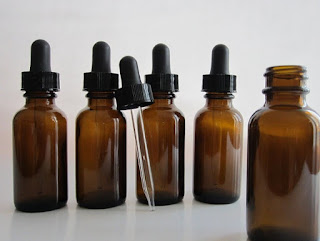
When your mixture is ready, you will now need a strainer, a tiny funnel, and some little tincture bottles with the dropper thingy.  You first pour the mixture through a strainer and into another jar, which will be your pure, filtered tincture that you will be using.  Now, you just need to funnel it into the dropper bottles.  Depending on what type of herb it actually is, you use the tincture daily or whenever needed by simply adding several drops of the extract into water or whatever beverage you like to add it to. [Edit: Some people prefer to place a few drops under the tongue for faster absorption.] Yep, simple as that.  

As you can see, it really doesn't call for a lot of supplies.  It just takes several weeks to extract the herb into the solution, but that's not a big deal.  Tinctures are mainly for convenience anyway, but, like I said before, I'd much rather supplement my diet by taking the whole herb in capsule form. Cheers!

* If you're in need of some of those cool-looking tincture bottles with the dropper tops, Amazon has a decent selection.  If you'd like to browse through a few, click the image (affiliate link) below:

http://www.amazon.com/gp/search?ie=UTF8&camp=1789&creative=9325&index=industrial&keywords=tincture%20bottles&linkCode=ur2&tag=establishedca-20&linkId=TRK3A6RBITAEP4B7

---End of Post "Supplies: Make your own Herbal Tinctures"

Monday, May 25, 2015

How many days of rest should you allow for building muscle?

This particular query can't be answered with a universally numerical conclusion.  Many variables factor into how many days of rest one should have for optimal muscle building results.  However, I will go over a few scenarios in hopes that it helps paint a clearer picture.

First of all, no matter what type of Health & Fitness Guru Blog you are reading from, the best knowledge comes from personal experience.  Yeah, the stuff you have personally tried, tested and adjusted to your own genetic makeup.

While browsing through the Internet, I was surprised to see many of the health blogs saying the exact same answer, which was 24 to 48 hours of rest between workouts.  Personally, I disagree. For one, what type of workout?  How intense is it?  Are you concentrating on certain muscle groups per each workout or are you taking the shotgun approach?  How old are you?  Are you a beginner just starting to work out or are you a professional bodybuilder building massive muscles?  All of these things and many more factor into how many days of rest your muscles need for optimal growth and/or safe methods of building lean body mass.

The small groups of muscles like what are found in your forearms, for example, could be worked thoroughly almost daily while larger muscles like what are found in your chest, shoulders, hamstrings, etc., will most likely need more time to fully recover from a hard workout.  Your genetic makeup, hormone levels, overall health, age, hours of daily sleep, and so on, all affect how quickly your body recovers.

I have heard of many professional bodybuilders training 6 days a week, with only 1 off day.  But guess what?  They only train certain groups of muscles once a week.  Yep, so that means that they allow 7 days of rest per muscle group for building mass quantities of muscle.  However, you can rest assured that they totally tear down each muscle group during those days of pumping iron/working out.

The other thing you need to do is simply listen to your own body.  If you go back to the bench press and you still feel weak from a workout you did a couple days ago, wait a few more days before trying again.  I try to wait an extra day or two after I feel ready for another intense weightlifting session.  Always try to keep in mind, your muscles grow when you are resting, not when working 'em to the point of exhaustion.

With that being said, aerobic-style workouts don't really need "days of rest" in between, but it never hurts to have a couple off days during the week, right?  As for building muscle, lifting weights, intense training, etc., I like to take 6 to 7 days off between working that same muscle again.  For optimal gains, even if I was in a big rush, I still wouldn't want to take any less than 4 or 5 days off, but that's just my opinion; cheers!

Image Credit: https://commons.wikimedia.org/wiki/File:African_Lion_Resting_at_the_Entebbe_Zoo_in_Uganda.jpg

---End of Post "How many days of rest should you allow for building muscle?"

Related Post:
http://health-fitness-guru.blogspot.com/2010/12/gain-mass-dont-overtrain-your-muscles.html

Recent Post:
http://health-fitness-guru.blogspot.com/2015/01/the-reason-pork-rinds-skins-are-not.html

Does Vitamin C help with Muscle Soreness?

Now here is another debatable subject in the health & fitness genre...  Does the antioxidant properties of the beloved Vitamin C really have much impact when concerning muscle soreness?  I suppose the best answer may be:  "It couldn't hurt."

Before we go any further, there are now major debates and issues with what causes muscle soreness.  Yeah, can you believe that?  Ha!  But seriously, now that many trending scientific articles say that lactic acid isn't to blame for that delayed soreness you feel after an intense workout the next day or even the day after the next, things have gotten a bit complicated and, uh, stupid.

Of course lactic acid buildup would actually cause soreness, but since the lactic acid is said to leave the area quickly after your moments of exertion, they are blaming it mostly on microscopic muscle tears.  This sounds cute and all, but why can you simply get sore from an odd movement, prolonged flexing, or even cramps, for example?  Does that involve microscopic tissue tears?  LOL! Muscular acidosis can occur any time your oxygen is depleted in a certain area of your muscles, but that's another subject.

Before anybody gets their panties in a wad, of course a lot of the soreness comes from muscle tears and strains, whether it is micro or macro in size.  However, to sweep lactic acid under the rug while ignoring all of the other metabolic byproducts that occur at the scene of stress during strenuous exercise, is a bit ignorant to say the least.  At any rate, let's just drop the whole "what causes muscle soreness?" debate, and quickly move right through this Vitamin C craze.

In a thumbnail, Vitamin C can help pull out some of the acid buildup and byproducts that puddle around the strained muscles in question.  It is no miracle cure or anything, but there is some evidence that shows it could help.  The inflammation and tissue damage that occurs is a good thing, though, if you plan on building bigger muscles.  As you should all know, your muscles grow while resting, not when getting worked and/or stripped down during intense exercise. I've read some scientific evidence before that states that taking too many anti-inflammatory substances to combat muscle soreness may actually hinder the recovery process.  Hey, what's that old adage again: "No pain; no gain!"  Anyway...

Vitamin C can also help build collagen, which is very important for the repair of connective tissues, muscles, etc.  In fact, if you don't believe me, perform a quick web search with the keywords "collagen helps build muscles" or "how exercising produces collagen" or "vitamin c helps build collagen," and so on.

I may have slightly gotten off topic here, but the point is, Vitamin C definitely doesn't hurt anything when concerning muscle soreness and the recovery process. 

Image Credit/Source:
http://health-fitness-guru.blogspot.com/2014/12/grapefruit-is-not-good-for-detox-or.html

End of Post "Does Vitamin C help with Muscle Soreness?"

Random Health & Fitness Posts:

* http://health-fitness-guru.blogspot.com/2010/11/creatine-is-waste-of-money-for-most.html
* http://health-fitness-guru.blogspot.com/2010/11/methods-for-building-powerful-forearms.html
* http://health-fitness-guru.blogspot.com/2010/11/mystery-of-muscle-memory.html

Eating every 3 hours is not required for Bodybuilding

This particular 'frequent eating for bodybuilding' subject has really gained momentum over the last few years.  I'm not exactly sure why, but, like most things, it has probably propagated online more than anywhere else.

At any gluttonous rate, there are some pros to eating smaller, more frequent meals for some folks. Will it ultimately lead to enhanced muscle growth?  Not normally.  I'm yet to see any conclusive evidence that proves that eating protein (or whatever) every 3 hours is required for enhanced muscle growth, when compared to the traditional 3 meals a day - with or without a few snacks.

Two primary food-related things to factor in outside of your exercise regimen for the semi-normal person that isn't taking steroids and/or growth hormones:  1) Total caloric intake 2) Quality protein intake

3 meals of the same caloric value as 6, 7, or 8 meals shouldn't make a difference when concerning muscle growth and/or bodybuilding.  Since protein is overrated, it shouldn't be hard for a human being living in the 21st century to find enough quality protein with 3 fairly balanced meals per day.  However, since the body can only process so much protein at once, it would be a good idea to somewhat spread it out as opposed to consuming 90% of your protein in one meal.  You know, common sense can go a long way; ha!

Perhaps where this "eating every 3 hours is required for building massive muscles" thing gets more credit, is from the steroid-abusing bodybuilding freaks that inject "juice," workout constantly and eat all day to achieve monster status.  If that is your goal, then please ignore this common sense post.  I'm not about to type out a long post about the dangers of PEDs (performance enhancing drugs) or steroids, etc.  It is your body and it is up to you to decide on how you want to tax it.  And no, I'm not talking about natural supplements like Force Factor - Natural Testosterone Boosters. On the other hand, I did once write a post about alcohol abuse and how to combat the withdrawal symptoms.

In conclusion, this post was merely written in an opinion-style and didn't really provide scientific evidence for or against frequent eating for enhanced muscle gains. However, I have read numerous scientific pages and claims from both sides in the past, and my opinion still stands.  On the other hand, if you think that you have a valid point in favor for eating every three hours and really believe that it's required for ultimate bodybuilding, feel free to share your comments below; cheers!

If not, here is another debatable subject:
http://health-fitness-guru.blogspot.com/2012/10/working-out-your-lower-body-to-build.html

Image Credit: Public Domain - Wikimedia Commons

---End of Post "Eating every 3 hours is not required for Bodybuilding"

Random Post:
http://health-fitness-guru.blogspot.com/2011/05/peaked-stuck-leveled-out-in-progress.html